

Originally posted on Multiple Sclerosis News Today
As I’ve mentioned in previous columns, I’m now pursuing a doctorate in educational psychology at the University of Texas at Austin. Given that work, 99.9% of my day revolves around typing, despite my multiple sclerosis (MS).
My journey as a typist began in high school, when I enrolled in a Microsoft Office course that taught the fundamentals of the suite’s various parts. We were also taught typing techniques, including proper finger positions over a keyboard.
On many days, my friend and I finished our assignments quickly, which let us partake in typing games online. I don’t remember exactly what those games entailed (thank my MS brain for the lack of memory) beyond that they involved competitive speed typing. For bragging rights, the teacher would post a list of the fastest typists at the end of the week, which made me work extremely hard on my skills.
Even as an undergraduate student, I picked up my typing pace because my field required many essays. When taking notes, however, I sometimes had to switch to an old-fashioned pen and paper because I couldn’t keep up with the speed of the lectures.
Actually, I prefer pen and paper because it grants some of my fingers the opportunity to rest. When typing, I’m using all of my fingers at all times, which has begun to cause distress in my hands. Now that I’m a graduate student and columnist for Multiple Sclerosis News Today, though, I’m constantly typing, which has caused me discomfort and, I suspect, a decline in grip strength.
Hand weakness and MS
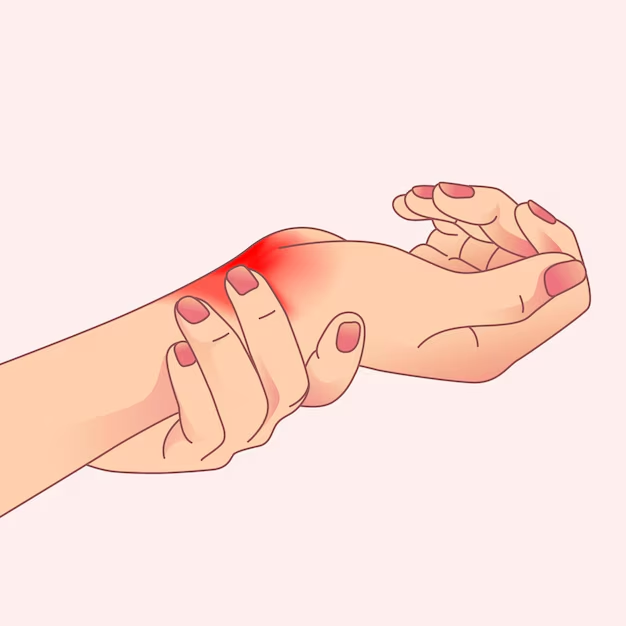
Some of the common symptoms of MS that affect the hands are tremors, weakness, lessened grip strength, and wrist drop, which can be accompanied by numbness, tingling, and pain from mild to severe. These issues can make it increasingly difficult to perform everyday tasks, such as picking up objects, eating with utensils, or buttoning clothes.
Of the common hand symptoms, decline or loss of grip strength has been a prominent variant throughout my MS journey. Before finding the appropriate medication, I had a tremor in my right hand for a year or two. But as the days pass lately, my hands have felt increasingly weak and numb.
I can’t say for sure that my constant typing is the main contributor to my progressive hand weakness and numbness, but it sure doesn’t help the situation. Although this new symptom causes a considerable amount of discomfort, it hasn’t slowed down my typing much. But I do have to take prolonged breaks every so often.
When a new symptom arises, I typically head straight to Google and Multiple Sclerosis News Today social media platforms to search for strategies and remedies to find relief. During a recent search, I stumbled upon hand therapy equipment that’s supposed to improve or maintain hand function, reduce stiffness, and strengthen hand coordination.
This discovery is the beginning of my journey to improve every aspect of my hands and fingers’ function.